
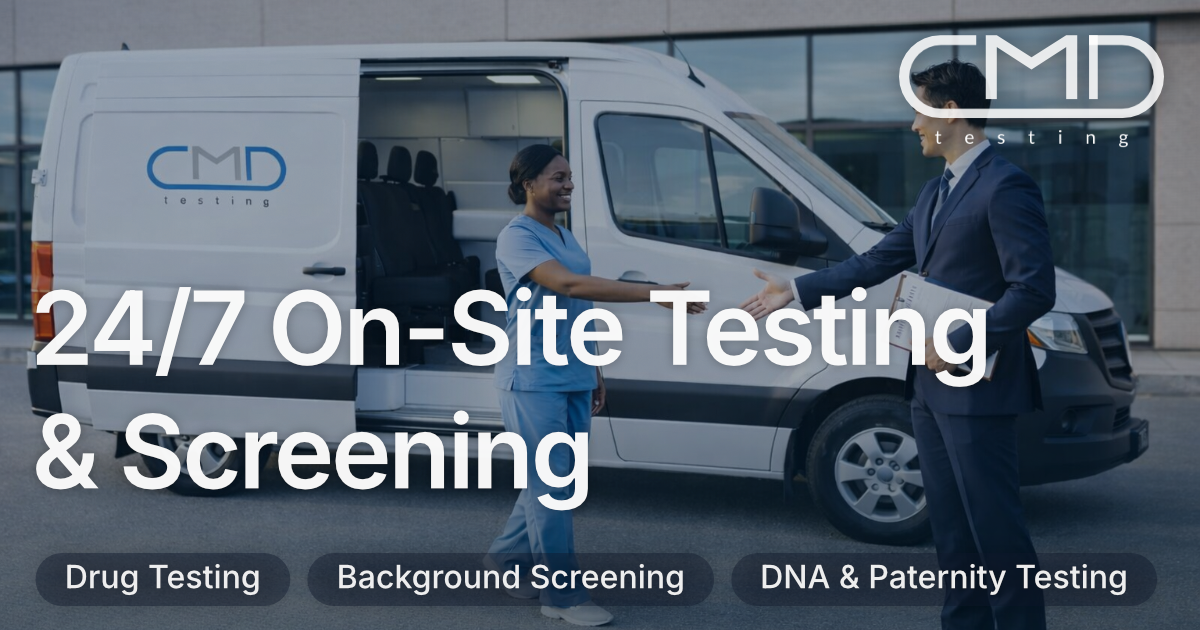
A request for post-accident or suspicion testing usually starts with a practical question: how do we complete the right service in Philadelphia, PA without creating unnecessary travel or confusion? Complete Mobile Drug Testing has provided testing and screening services since 2011, with 24/7 mobile availability and a workflow built around trained professionals and clear documentation. That combination of local coordination and process control is what gives this post-accident or suspicion testing practical value.
Reasonable-suspicion testing should likewise be tied to documented observations and the governing policy, not used as a label for every workplace concern. For service in Greater Philadelphia, that point matters because the customer needs a prompt, defensible collection process tied to the correct testing reason.
For non-DOT workers, the written company policy and applicable law should control the decision instead of borrowing federal criteria that do not apply to that employee. Reasonable suspicion testing likewise depends on observations and the applicable policy or regulation rather than a hunch. For customers across Greater Philadelphia, we use those details to keep the post-accident or suspicion testing appropriate for its intended purpose.
For a Philadelphia, PA request, the cleanest workflow begins with classification rather than dispatch. For this post-accident or suspicion testing, we define the service purpose first, then coordinate the site, participant or employee information, required records, and the result path needed to support a prompt, defensible collection process tied to the correct testing reason.
Sharing the purpose early lets us build this post-accident or suspicion testing around the right test, report, or relationship evidence. Across Greater Philadelphia, that supports a prompt, defensible collection process tied to the correct testing reason without unnecessary repeat work.
Greater Philadelphia combines dense urban locations, campuses, hospitals, warehouses, construction sites, transportation operations, and suburban workplaces. Local scheduling is most useful when it is paired with clear instructions about the test reason, required identification, and who is authorized to receive the result. This service is most useful locally when it solves the travel problem while still delivering a prompt, defensible collection process tied to the correct testing reason. Consider a supervisor arranging a documented collection for an employee whose normal workday is nowhere near a testing clinic. The most efficient answer is often a correctly classified service at the right location, rather than a separate trip that adds no value to the record.
The current service model includes 24/7 mobile availability for testing needs that do not fit a standard clinic schedule. Drug test results, consumer reports, and DNA findings contain sensitive information, so access should stay limited to authorized people. For customers in Greater Philadelphia, we apply those same boundaries to the post-accident or suspicion testing so convenience does not replace the rules, documentation, or evidence standard behind the request.
These CMDT pages connect the post-accident or suspicion testing with related service, location, and scheduling information for Greater Philadelphia.
We coordinate the post-accident or suspicion testing, while the sources below provide independent legal, regulatory, or accreditation context for Greater Philadelphia.
Q: For a Philadelphia, PA request, why does timing matter after an accident?
A: Some regulated tests have defined windows and records requirements. Early coordination also reduces the risk that the employee, supervisor, or collector is unavailable when the test needs to occur. For service in Greater Philadelphia, we confirm that distinction before the post-accident or suspicion testing is scheduled.
Q: In Philadelphia, PA, should the employer investigate the accident and testing result together?
A: Testing is only one part of incident response. Employers should preserve their normal safety investigation, medical response, documentation, and policy processes rather than treating a test result as the entire investigation. We use that point when organizing the post-accident or suspicion testing for customers in Greater Philadelphia.
Q: What supports a reasonable suspicion decision in Philadelphia, PA?
A: The decision should be based on specific, contemporaneous observations and the employer policy or applicable rule. Regulated programs may require supervisor training. We use that point when organizing the post-accident or suspicion testing for customers in Greater Philadelphia.
The service event should end with a clear handoff. For this post-accident or suspicion testing across Greater Philadelphia, that means knowing where the specimen or screening order goes, who receives the reported result, what supporting records should be retained, and whether the customer has another deadline after the appointment. This is particularly important in DOT programs, employment screening, and legal DNA work, where the collection is only one part of a larger process. Treating the final record as part of that workflow helps prevent a correctly performed service from being mishandled later.
For a scheduled or time-sensitive request in Philadelphia, PA, tell us what you need from this post-accident or suspicion testing and the timing you are working around. We will coordinate the service around the actual situation.


Professional drug testing and background screening services since 2011. Trusted by Fortune 500 companies nationwide.
Available 24/7 with mobile testing units
CWOB Certified
NDASA Member
Investment ranges and details are governed by the CMDT Franchise Disclosure Document (FDD)