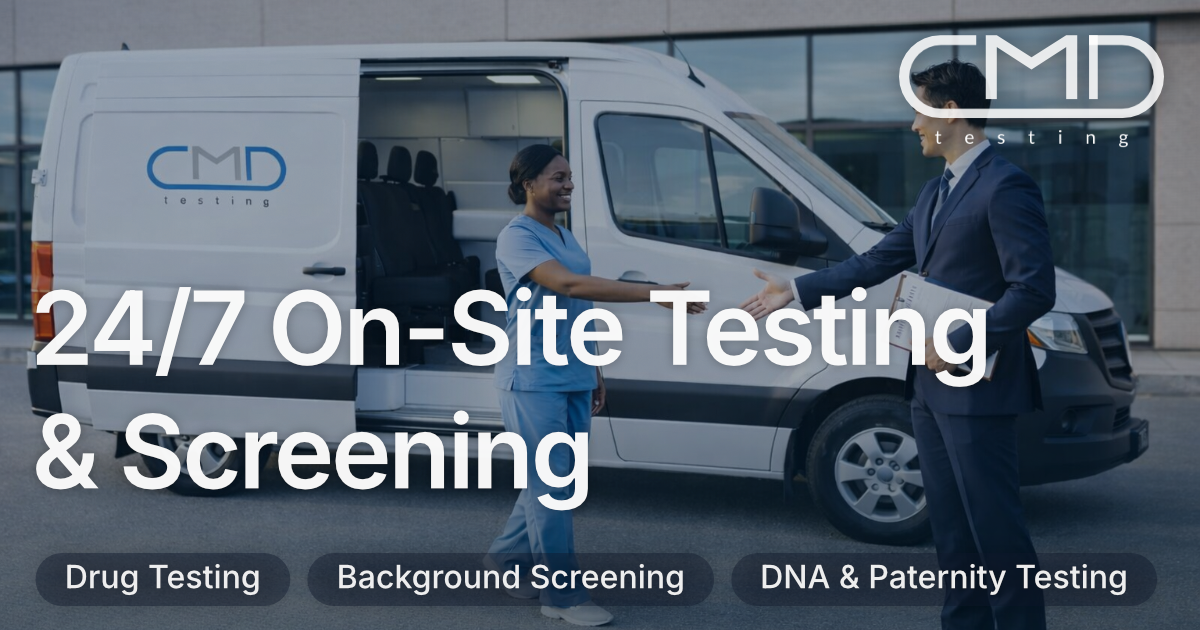
For employers responding to incidents or documented signs that trigger testing under policy or regulation in Phoenix, AZ, a request for post-accident or suspicion testing is usually tied to a real deadline, policy, legal purpose, or work schedule rather than a generic testing appointment. CMDT has operated since 2011 and provides 24/7 mobile testing support along with background screening and DNA services, using documented processes designed to keep customers organized. That combination of local coordination and process control is what gives this post-accident or suspicion testing practical value.
Reasonable-suspicion testing should likewise be tied to documented observations and the governing policy, not used as a label for every work site concern. For service in the Phoenix Valley, that point matters because the customer needs a prompt, defensible collection process tied to the correct testing reason.
After an accident, medical care and immediate site safety come before the testing appointment. DOT post accident rules are tied to specific triggering criteria and timing requirements; a workplace incident does not automatically create a federal test. For customers across the Phoenix Valley, we use those details to keep the post-accident or suspicion testing appropriate for its intended purpose.
Before an appointment is set in Phoenix, AZ, we identify the intended use, the people involved, timing constraints, and any DOT, legal, laboratory, or employer-policy rules that change this post-accident or suspicion testing. Once those points are clear, location becomes much easier to solve.
Sharing the purpose early lets us build this post-accident or suspicion testing around the right test, report, or relationship evidence. Across the Phoenix Valley, that supports a prompt, defensible collection process tied to the correct testing reason without unnecessary repeat work.
Heat, distance, and changing field schedules make practical appointment planning important, but the collection environment still has to support the required procedure. The Phoenix Valley combines long cross-metro travel with worksites that can change as projects, routes, and staffing needs shift. This service is most useful locally when it solves the travel problem while still delivering a prompt, defensible collection process tied to the correct testing reason. One local planning example is an employer onboarding several candidates assigned to different locations across the Valley. That is where mobile coordination earns its value, provided the required documentation and service standard stay intact.
Drug test results, consumer reports, and DNA findings contain sensitive information, so access should stay limited to authorized people. The company emphasizes trained professionals, documented handling, and controlled delivery of sensitive results. For customers in the Phoenix Valley, we apply those same boundaries to the post-accident or suspicion testing so convenience does not replace the rules, documentation, or evidence standard behind the request.
For this post-accident or suspicion testing, these CMDT pages provide current service and location context for the Phoenix Valley.
We coordinate the post-accident or suspicion testing, while the sources below provide independent legal, regulatory, or accreditation context for the Phoenix Valley.
Q: Does every workplace accident require a drug test in Phoenix, AZ?
A: No. The answer depends on the employer policy and, for DOT covered covered workers, the specific post accident criteria in the applicable agency rule. For service in the Phoenix Valley, we confirm that distinction before the post-accident or suspicion testing is scheduled.
Q: For post-accident and suspicion testing in Phoenix, AZ, can testing be performed at the job site?
A: Often, yes. A mobile collector can help reduce travel after an incident, provided the site can support an appropriate collection and the situation is medically safe. For service in the Phoenix Valley, we confirm that distinction before the post-accident or suspicion testing is scheduled.
Q: In Phoenix, AZ, should the employer investigate the accident and testing result together?
A: Testing is only one part of incident response. Employers should preserve their normal safety investigation, medical response, documentation, and policy processes rather than treating a test result as the entire investigation. We use that point when organizing the post-accident or suspicion testing for customers in the Phoenix Valley.
After this post-accident or suspicion testing is complete, the result or report still belongs to a larger workflow. A Phoenix, AZ employer may need to retain records, complete a regulatory step, make an individualized hiring decision, or route a result only to authorized personnel. A family may need to preserve DNA paperwork for an agency or legal matter. The mobile location does not change those responsibilities. We encourage customers to decide who receives the final information, what action is permitted next, and whether another regulated or legal step is still required before the matter is considered closed.
Ready to arrange post-accident or suspicion testing in Phoenix, AZ? Tell us who needs the service, why it is being requested, and the schedule you are working around. We will help organize the correct path.


Professional drug testing and background screening services since 2011. Trusted by Fortune 500 companies nationwide.
Available 24/7 with mobile testing units
CWOB Certified
NDASA Member
Investment ranges and details are governed by the CMDT Franchise Disclosure Document (FDD)